Structure recovery
Recover bonds, bond orders, formal charges, and radical states from elements, three-dimensional coordinates, charge, and multiplicity.
Metal-complex example
The example is a Gaussian 16 single-point calculation:
download mn_complex_sp.log. The source has no molecular
graph; MolOP invokes MolGR when frame.rdmol is first accessed.
from rdkit import Chem

from molop import AutoParser

frame = AutoParser("mn_complex_sp.log", n_jobs=1)[0][-1]
mol = frame.rdmol

if mol is None:
    raise RuntimeError("structure recovery failed")

mn = next(atom for atom in mol.GetAtoms() if atom.GetSymbol() == "Mn")
dative_count = sum(bond.GetBondType() == Chem.BondType.DATIVE for bond in mol.GetBonds())

print(frame.formula)
print(f"{mol.GetNumAtoms()} atoms, {mol.GetNumBonds()} bonds")
print(f"Mn charge {mn.GetFormalCharge():+d}, degree {mn.GetDegree()}")
print(f"{dative_count} dative bonds")
print(frame.topology_reconstruction_backend, frame.topology_reconstruction_status)
Real output and molecular graph
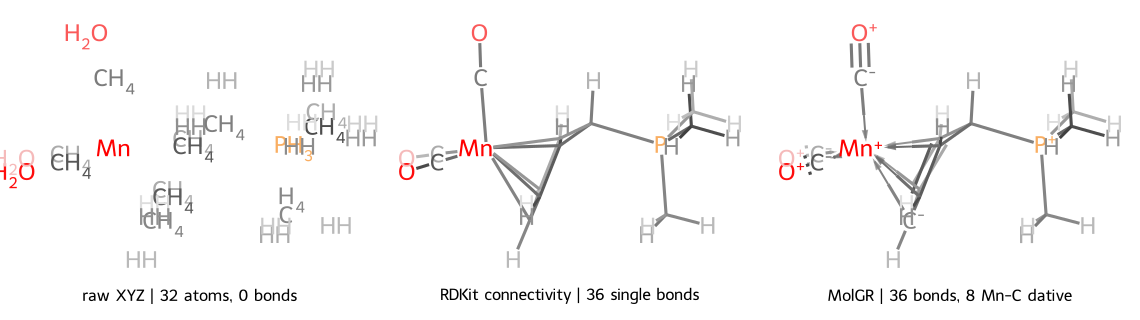
| Treatment | Bonds | Mn coordination | Result |
|---|---|---|---|
| Raw XYZ | 0 | None | Elements and coordinates only |
RDKit DetermineConnectivity |
36 | 8 SINGLE bonds |
Distance connectivity without bond-order semantics |
RDKit DetermineBonds(charge=1) |
- | - | Raises ValueError because Mn has no predefined valence |
| MolGR | 36 | 8 DATIVE bonds |
Also recovers ligand bond orders, formal charges, and coordination bonds |
The SVG is generated from the three real molecular objects for the same calculation with
MolOP’s default rdkit-dof drawer. The script does not edit SVG paths by hand.
The distinction is not whether 36 atom pairs can be connected, but which chemical semantics are recovered. RDKit can connect atoms by distance but cannot assign a valence to Mn. MolGR represents all eight Mn-C bonds as coordination bonds while assigning ligand bond orders and charges.
Configure recovery globally
Recovery settings belong to the process-wide molopconfig, not to an individual Molecule:
from molop import molopconfig

molopconfig.graph_reconstruction_backend = "python"  # default: "cpp"
molopconfig.reconstruction_failure_policy = "return_suspicious"  # default: "raise"
molopconfig.make_dative_bonds = False  # default: True
molopconfig.make_stereochemistry = False  # default: True
molopconfig.prewarm_topologies = True  # default: False
Set these values before the first access to rdmol for a frame. Lazy reconstruction reads the
current global values and records the effective settings on the frame. Restore the defaults or use a
separate process when different workflows require different policies.
Set reconstruction_failure_policy to "return_suspicious" when an invalid or otherwise
unreconstructable geometry must still be retained. MolOP keeps MolGR’s unsanitized fallback RDKit
molecule, records topology_reconstruction_status == "suspicious_fallback", and preserves the
failure diagnostics. The default "raise" policy records the same case as failed and exposes no
RDKit molecule.
Optional native parallel prewarming
Graph-dependent operations use lazy reconstruction by default. MolOP’s process-parallel entry points
use spawn-like loky workers, so the worker that consumes a graph can build it without a separate
parent-process warmup step. Set molopconfig.prewarm_topologies = True when a workflow benefits from
an eagerly populated parent-side cache. Existing graphs and already-attempted frames are skipped, and
frames with different backend, dative-bond, or stereochemistry settings are submitted as separate
homogeneous batches so provenance remains correct.
When enabled, prewarming is used by:
- batch
format_transform()for graph writers (sdf,smi,cml); - Gaussian
format_transform("gjf", add_gjf_connectivity=True); - frame-level
to_summary_df()for a file or a batch; - trajectory, vibration, and TS-vibration animation;
- TS pre/post candidate inference and its summary/export paths remain lazy: these endpoints are generated dynamically from each TS frame, so a fresh loky worker may reconstruct temporary candidates instead of receiving a parent-built candidate map.
filter_custom()andgroupby()callbacks. Because these callbacks are arbitrary, MolOP warms every eligible frame in the input snapshot before dispatching them to loky, even when a particular callback happens to inspect metadata only.
Source-evidence capture is deliberately graph-free: attaching source spans, hashes, parser
provenance, and parse diagnostics never reads frame.rdmol and never invokes MolGR. Topology remains
lazy and is reconstructed only when a later graph-dependent operation explicitly requests it.
Operations with an enumerable source-frame set prewarm those frames with MolGR’s native batch API in the parent before outer joblib/loky processes start only when the option is enabled. Operations that generate temporary graph candidates while running, such as TS endpoints, keep the normal public call path and may perform single-molecule lazy reconstruction inside a fresh loky worker. The worker process must be created by spawn/loky; a fork child is rejected by MolGR’s PID guard before native code runs.
This boundary also applies to explicit threading backends and nested parallel calls: if a callback
tries to trigger an unprewarmed reconstruction while MolOP parallel work is active, MolOP fails fast
with a concurrency error instead of waiting on a self-deadlocking pool. The molecule remains
retryable after this scheduling error.
The native guard covers both loky and joblib’s multiprocessing child processes. It also refuses to start while an unrelated external loky executor still has pending work; consume or close that result before starting a graph-dependent operation. An idle reusable pool is drained before MolGR starts.
The guard also rejects live Python child processes that are not managed by MolOP, including external
multiprocessing and loky.ProcessPoolExecutor workers. Join or close those processes first; without
that boundary MolGR’s native pool cannot be proven independent from them.
Do not call os.fork() after MolGR native prewarming, or switch a graph-dependent task to a
fork-based multiprocessing backend. Forking can copy native runtime state that Python cannot
fully guard. MolOP-managed process-parallel entry points explicitly select joblib’s loky backend;
loky uses an independent-interpreter, spawn-like boundary and does not inherit the parent’s MolGR
native runtime through POSIX fork. MolOP deliberately does not mutate Python’s global
multiprocessing start method or wrap joblib’s legacy multiprocessing backend with standard
spawn, which would disrupt notebooks, interactive entry points, and caller-owned process
configuration. MolOP entry points normalize only joblib’s legacy multiprocessing configuration to
loky; outer threading and third-party backends are preserved, and an explicit backend argument on
the MolOP parallel API remains the compatibility override. Keep graph-dependent work on loky and
workers read prewarmed source-frame caches where available and may lazily reconstruct dynamic
single-molecule candidates. The native batch adapter itself remains a parent-process operation and
rejects invocation from a worker, preventing nested MolGR native pools.
The native batch adapter validates request identity and completion. Duplicate or unknown results are
treated as a batch error; if the iterator stops early, every missing frame is marked failed and will
not retry native reconstruction from a worker. Closing or exhausting an outer joblib iterator releases
its process-pool guard. MolGR does not currently expose a Python timeout or hard cancellation hook, so
a hung native call remains a process-level failure boundary rather than something MolOP can interrupt
in the same process.
suspicious_fallback keeps the private native molecule only as raw evidence and never invents a
disconnected graph from empty ordinary topology fields. If a user-defined serializer drops that
private cache, a worker fails closed with an empty graph instead of fabricating an incorrect topology.
When enabled, the operation’s existing n_jobs value controls the native prewarm limit for enumerable
batch summaries and format conversion. Coordinate-only xyz, ORCA input, and Gaussian coordinate
renders keep lazy graph behavior and do not force reconstruction merely because they are converted.
Status values
| Status | Meaning |
|---|---|
provided |
The source format provided bonds, formal charges, and radicals |
succeeded |
MolGR obtained a normal coordinate-derived candidate |
suspicious_fallback |
A usable fallback candidate needs review |
failed |
No RDKit molecule could be built; rdmol is None |
None |
Topology access has not run yet, or no status applies |
When MolGR reports a non-fatal item failure or suspicious fallback,
frame.topology_reconstruction_diagnostics retains its stable code, stage, backend,
counts, details, and cause fields. This ordinary dictionary is preserved when a prewarmed frame
is serialized to a loky worker.
Why review matters
Recovering topology from geometry is not unique. Close contacts, ion pairs, radicals, metal
complexes, and distorted geometries can admit several plausible bonding assignments. A
suspicious_fallback may still be useful, but should not enter a high-confidence database without
inspection.
Provide charge and multiplicity
Override missing source values at the parser entry point:
batch = AutoParser(
    "radical.xyz",
    total_charge=0,
    total_multiplicity=2,
)
mol = batch[0][0].rdmol
These values affect recovery. Do not guess them merely to make reconstruction succeed.
Check before exporting
frame = batch[0][-1]
mol = frame.rdmol

if mol is not None and frame.topology_reconstruction_status != "suspicious_fallback":
    print(frame.to_canonical_SMILES())
Graph-level SDF, SMILES, and CML writers need a usable molecular graph. XYZ and coordinate-mode Gaussian/ORCA inputs can still export coordinates without preserving full topology semantics.